




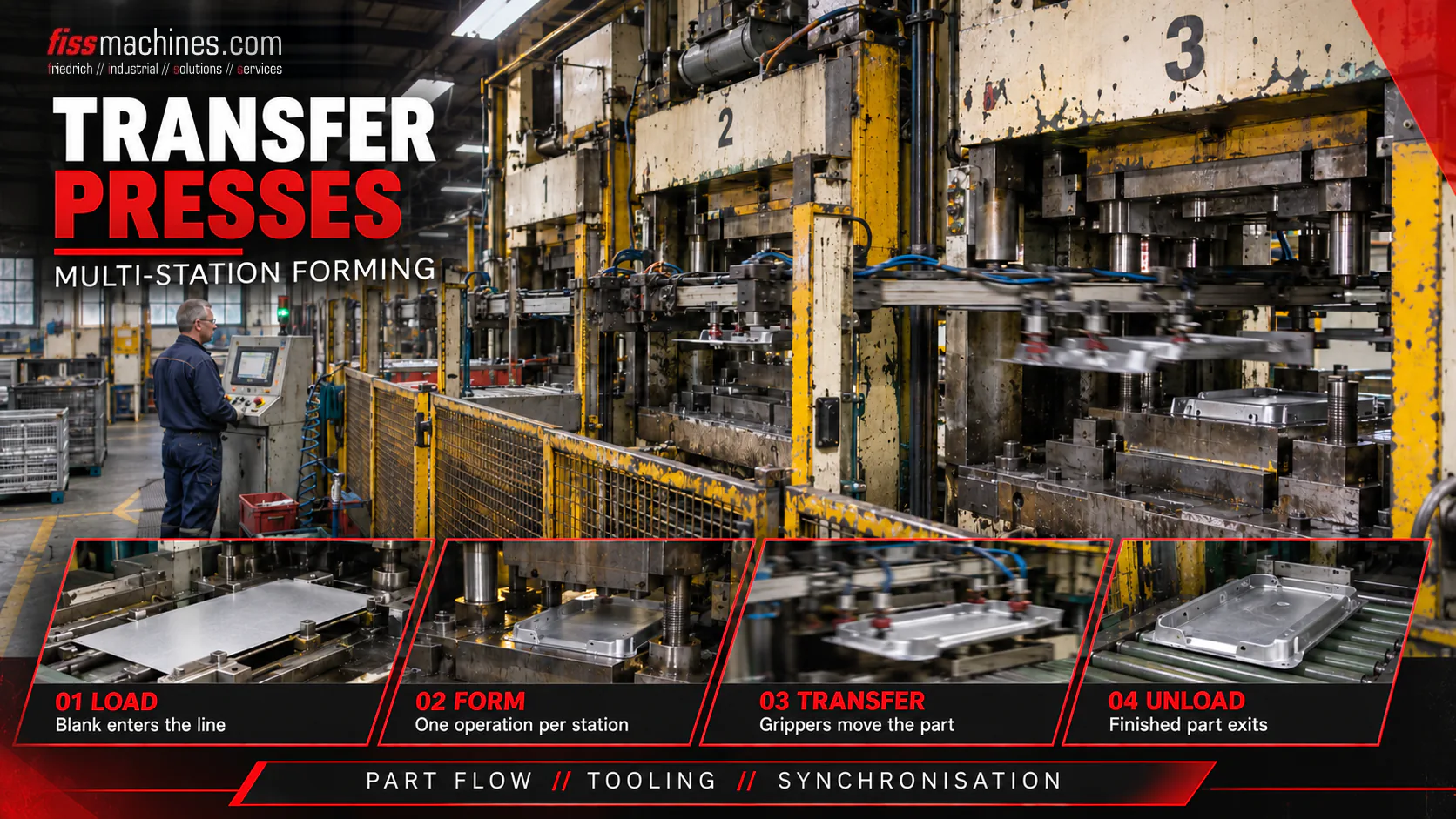
Transfer Presses Explained: Transfer Systems, Applications and Buying Used
Deep-drawn housings, brackets and structural parts often need four, five or more forming operations. A transfer press performs them in one machine, with an automation system that carries the part from die to die. For planners and buyers, the transfer system matters as much as the press itself.
What Is a Transfer Press?
A transfer press is a single press in which several die stations sit side by side under the slide, and an integrated transfer system moves each part from one station to the next with every stroke. One stroke closes all dies at once, so a finished part leaves the last station each cycle.
FISS describes transfer presses as “multi-stage forming with integrated transfer between the individual tool stations”. Unlike a progressive die, the blank is separated from the strip before or at the first station and travels on as a single piece.
Transfer Press vs Progressive Die vs Tandem Press Line
Three concepts compete for multi-stage sheet metal parts: the progressive die, the transfer press and the tandem press line of several presses in a row. The choice depends on part size, draw depth, batch size and floor space.
| Concept | Part Handling | Strengths | Limitations |
|---|---|---|---|
| Progressive die | Part stays attached to the strip until the final cut | Very fast; one or more parts per stroke | Part size limited by the strip; complex dies need high volumes |
| Transfer press | Separate blank moved between stations in one press | Larger and deeper parts; one machine footprint | Slower than a progressive die; transfer tooling for each part |
| Tandem press line | Separate presses linked by robots or crossbar feeders | Largest parts; each press set individually | Most floor space and investment; more interfaces |
The metal parts manufacturer Minifaber summarises the trade-off: transfer dies are generally considered more suitable for large parts and more cost-effective for smaller batches, while progressive dies produce much faster. Schuler describes its Intra Trans tri-axis transfer as “a genuine alternative to progressive die manufacturing” (manufacturer statement).
Transfer Systems: 2-Axis, 3-Axis, Crossbar and Servo Transfer
The transfer system decides which parts a transfer press can handle and how fast it runs.
Feed and Lift
Clamps lift the part and move it forward; there is no separate in-out axis. AIDA specifies its NCAH III with a two-axis feed/lift servo drive for 3 to 6 processes on one machine (manufacturer statement).
Gripper Rails
Two rails close in, lift, feed, lower and open again – in-out, up-down and forward-back. Fingers grip the part from both sides.
Bars Across the Die Space
Bars span the die area and pick parts from above, usually with suction cups, dwelling between the dies on each stroke. Suited to large panels.
Programmable Motion
Servo motors drive each axis, so feed, lift and clamp strokes change without mechanical cams. Older transfers are often cam-driven.
Schuler specifies its AT1, AT2 and AT3 tri-axis transfers with feed strokes of up to 500, 1,000 and 2,000 mm and lift strokes of up to 100, 200 and 500 mm (manufacturer statement, accessed 6 November 2026). Transfer size must match part size and station pitch.
Transfer Press Drives and What Manufacturers State
Transfer presses are built with mechanical, hydraulic and servo drives; what matters here is how press and transfer are synchronised. Schuler lists transfer and multi-station presses in mechanical, hydraulic and TwinServo versions.
Transfer Pioneer
Schuler’s company history names the first transfer press at the 1900 World Exhibition in Paris and the first large panel transfer press with crossbar transfer in 1990. Müller Weingarten joined Schuler in 2007.
Servo Transfer Units
AIDA lists its NCAH III intra-press transfer with feed strokes of 200 to 600 mm, lift strokes of 20 to 60 mm and a conveyance weight of up to 3.0 kg.
Multi-Station Alternative
synchropress GmbH (Hövelhof) builds servo spindle presses from 500 to 10,000 kN and states that further processing stations can be integrated in a longer working area.
These are manufacturer statements from their own websites (accessed 6 November 2026), not independent tests.
Typical Parts and Materials for a Transfer Press
Transfer stamping is used in medium- to high-volume production. A typical transfer press sequence combines drawing, redrawing, trimming, piercing and flanging in successive stations.
- Deep-drawn parts: housings, cups and shells with several draw steps – the separate blank flows more freely than in a strip.
- Structural parts: brackets, reinforcements and cross members, including high-strength steels.
- Materials: typically sheet steel and aluminium. Material, thickness and draw depth define force and die cushion requirements.
FISS lists used machines for such work under mechanical presses and hydraulic presses.
Die Change and Tooling on a Transfer Press
On a transfer press, each part needs its own transfer tooling – gripper fingers, suction cups or crossbar tooling – matched to dies and station pitch. A part change typically runs in five steps.
Move Out the Die Set
Dies on moving bolsters are changed as a complete set.
Change Transfer Tooling
Part-specific rails or crossbar tooling are replaced. Schuler states that its transfer rails use a coupling with integrated sensors and offers automated rail changeover as an option (manufacturer statement).
Load Motion Data
Servo transfers store motion curves per part; cam transfers need mechanical adjustment.
Set the Die Cushion
Die cushion force and stroke are set for part and material.
Try Out and Release
Single strokes at low speed check transfer and interference.
Automation and Safety at the Transfer Press
A transfer press is a highly automated system from coil line or destacker to outfeed conveyor. Press and transfer must be synchronised so that grippers never collide with the closing dies; sensors in the dies and transfer tooling typically check part presence and position.
Buying or Relocating a Used Transfer Press
A used transfer press pays off when press force, bed size, station count and transfer stroke match the planned parts. AIDA, for example, offers a prior-purchase inspection to identify condition problems and component obsolescence before a used press is bought (manufacturer statement).
- Foundation: pit depth, anchoring and load capacity at the new site; many large presses are pit-mounted.
- Die cushions: type, force, stroke, hydraulics and leaks – essential for drawing stations.
- Transfer condition: rails, bearings, gripper units, drives and existing part-specific tooling.
- Press condition: slide guiding, clutch and brake, overload protection and lubrication.
- Controls: age, spare parts and the synchronisation of press and transfer.
- Documentation: electrical diagrams, hydraulic plans, maintenance records and manuals.
Large presses are relocated in units. In a Müller-Weingarten press line project, FISS dismantled the line over six months, raised press crowns of up to 250 tonnes with a lifting beam system and shipped the largest parts by road and waterway. FISS offers dismantling and transport as services and helps buyers find machines through its search service.
The Transfer System Decides the Press
A transfer press combines several forming operations in one machine and fills the gap between the fast progressive die and the large tandem line. Assess press and transfer together: transfer type, stroke and tooling decide which parts the press can run; foundation, die cushions, controls and documentation decide whether a used transfer press can be relocated economically.
Questions About Transfer Presses
What Is the Difference Between a Transfer Press and a Progressive Die?
In a progressive die the part stays attached to the strip until the final cut. In a transfer press the blank is separated first and moved between die stations by a transfer system. Transfer presses suit larger, deeper parts; progressive dies are faster.
What Is a 3-Axis Transfer?
A 3-axis transfer moves its gripper rails in three directions: in-out to grip the part, up-down to lift it and forward-back to feed it to the next station. A 2-axis transfer works with feed and lift only.
Can a Used Transfer Press Be Relocated?
Yes, large presses are dismantled into transportable units and rebuilt at the new site. Foundation, die cushions, transfer and controls must be checked in advance, and the safety concept must be assessed for the new location.
Does FISS Offer Transfer Presses?
FISS lists used presses in several categories and supports dismantling, transport and sourcing. Stock changes, so send a search request with press force, bed size and station count.
Used Presses and Relocation from FISS.
FISS lists used presses, searches for specific machines and supports dismantling, transport and recommissioning.
Sources
Schuler Group: Modular Electronic Tri-axis Transfers (overview and technology pages), Mechanical press lines with Crossbar Feeder automation, Automotive press technology and Corporate History of the Schuler Group, schulergroup.com, accessed 6 November 2026 (manufacturer statements).
AIDA Engineering: NCAH III Intra-Press Transfer and After Market Solutions, aida-global.com, accessed 6 November 2026 (manufacturer statements).
synchropress GmbH: synchropress® 4M and synchropress® Technologie, synchropress.de, accessed 6 November 2026 (manufacturer statements).
Minifaber: Transfer dies vs progressive dies: differences and advantages, minifaber.com, 9 September 2022, accessed 6 November 2026.
Wikipedia: Transfer stamping, en.wikipedia.org, accessed 6 November 2026.
FISS Machines: Mechanical Presses (category description), Dismantling and Transport of a Müller-Weingarten S 7300.06.260 Press Line and Dismantling, fiss-machines.com, accessed 6 November 2026.
