




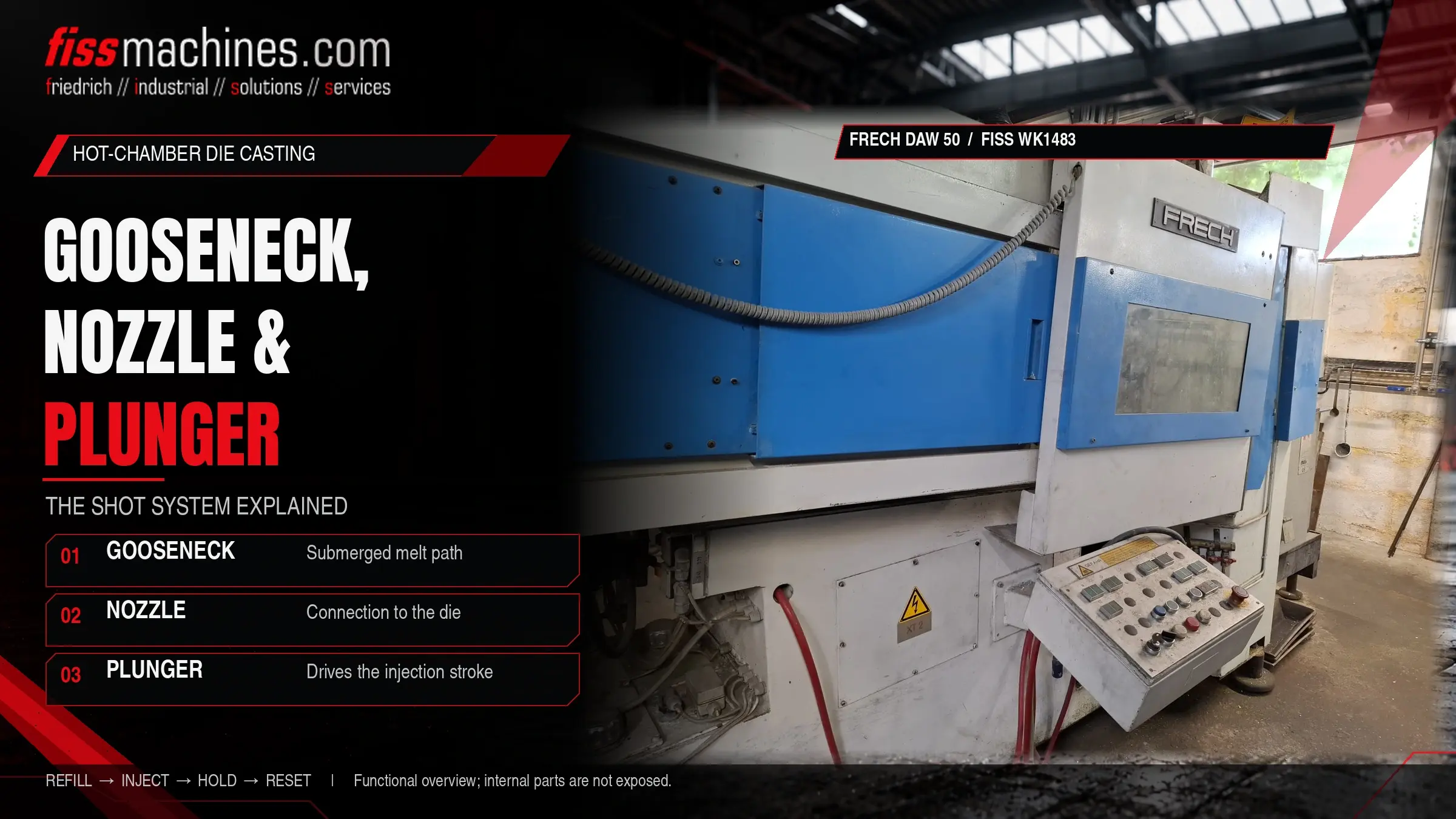
Gooseneck, Nozzle and Plunger: The Shot System of a Hot-Chamber Die Casting Machine
Every shot on a hot-chamber die casting machine depends on three components that sit directly in or next to the molten metal: the gooseneck, the plunger and the nozzle. Together they form the shot system that replaces ladling in zinc and magnesium die casting. Their condition decides whether shot speed, part weight and cycle time remain stable – and they are among the first things to check on a used machine.
What Do Gooseneck, Plunger and Nozzle Do?
The gooseneck is a cast metal body immersed in the melt. It contains the shot cylinder and a curved channel leading up to the die. The plunger moves inside the cylinder: when it retracts, melt flows in through a fill port; when it moves down, it pushes the metal through the channel. The nozzle connects the gooseneck to the sprue bushing of the die and must be kept hot so that the metal does not freeze in it.
Erosion by the melt, sliding wear between plunger and cylinder and thermal load at the nozzle are the main wear mechanisms. Typical consequences are slower fills, fluctuating part weights and metal leaking at the nozzle.
How the Hot-Chamber Shot System Works
In a hot-chamber machine, the shot system is part of the furnace. The gooseneck stands in the metal bath of the holding pot, so the shot cylinder is always filled with liquid metal at the right temperature. A separate metal transfer to the machine, as in cold-chamber die casting, is not required.
Filling
With the plunger retracted, the fill port in the cylinder wall is open and melt flows from the bath into the shot cylinder.
Injection
The plunger moves down, closes the fill port and pushes the metal through the gooseneck channel and the nozzle into the closed die. The shot is typically run in several speed phases.
Intensification and Solidification
The plunger holds pressure while the casting solidifies in the die.
Return
The plunger returns to its start position. Metal that has not solidified flows back through the nozzle and gooseneck, and the cylinder refills for the next shot.
Because filling happens automatically with every plunger return, hot-chamber machines achieve short cycle times. A basic comparison of both machine types is given in the article Cold Chamber or Hot Chamber?.
The Three Parts of the Shot System
Melt Container and Channel
Made of iron-based material. It houses the shot cylinder and the riser channel to the nozzle. Some designs use a replaceable sleeve or liner in the cylinder bore, so the body can be refurbished instead of replaced.
Shot Piston with Rings
Driven by the hydraulic shot cylinder above the bath. Piston rings seal against the cylinder wall. As rings and bore wear, more metal bypasses the plunger and less of the stroke reaches the die.
Heated Connection to the Die
Seats against the sprue bushing of the fixed die half. Depending on the design, it is heated by gas burners or electric heaters, because the metal in it must not freeze between shots.
The parts are matched to each other and to the machine: plunger diameter, cylinder bore, gooseneck geometry and nozzle length determine the available shot volume and the pressure on the metal. Changing one of them changes the process.
Where the Shot System Wears – and How It Shows
The shot system works permanently at melt temperature. Three mechanisms dominate: erosion and chemical attack of the bore and channel by the melt, sliding wear between plunger rings and cylinder, and thermal load at the nozzle, which is heated from outside and cooled at its contact with the die.
| Symptom | Possible Cause | What to Check |
|---|---|---|
| Fill time increases, shot speed drops | Worn plunger rings or cylinder bore, metal bypassing the plunger | Shot curve, ring condition, bore diameter |
| Part weight fluctuates | Leakage at the plunger, changing bath level | Ring condition, bath level control, ingot feeding |
| Metal leaks at the nozzle tip | Damaged seat at nozzle or sprue bushing, insufficient nozzle contact | Nozzle tip, sprue bushing, nozzle alignment |
| Metal freezes in the nozzle | Nozzle heating too low or failing | Burner or heater, temperature sensor, settings |
| Cold shuts or porosity increasing | Melt or nozzle temperature too low, unstable shot | Temperatures, shot profile, die temperature |
Zinc, Magnesium – and Why Aluminium Is Different
Çinko klasik kızgın hacim malzemesidir. Yaygın çinko döküm alaşımları düşük sıcaklıklarda eritilir – Nyrstar'ın Zamak 3 veri sayfası erime aralığını 381–387 °C olarak verir – bu da atış sistemine uygulanan termal yükü ılımlı tutar.
Magnezyum da kızgın hacim makinelerinde dökülebilir, fakat açıkça daha yüksek sıcaklıklarda ve eritme koruması ile güvenlik için kendi gereksinimleriyle. Magnezyum makineleri bu amaç için üretilmiştir; örneğin FISS envanteri, çinko için Frech DAW makinelerinin yanında özel Magnezyum kızgın hacim makinelerini de içerir.
Alüminyum demir bazlı malzemelere döküm sıcaklığında güçlü şekilde saldırır. Standart alüminyum alaşımları bu nedenle soğuk hacim makinelerde dökülür; alüminyum için kızgın hacim süreçleri sadece küçük parçalar için özel çözümler olarak mevcuttur. Alaşılar hakkında daha fazla bilgi Alüminyum, Çinko veya Magnezyum?
Atış Sistemini Stabil Tutmak
Yüzük değişim aralıkları, boğazın incelenmesi ve nozzle değiştirme, alaşım, çevrim hızı ve makine tasarımına bağlıdır; bu nedenle üreticinin dokümantasyonu referanstır. Günlük uygulamada aşağıdaki noktalar faydalı olmuştur:
- Nozul sıcaklığı ve ısıtma işlevinin sürekli izlenmesi, yalnızca arıza sonrası değil
- Her kalıp değişiminde nozul ucu ve akış borusu yatağının incelenmesi
- Çıkan plunger halkası değişimlerinin atış sayacı okumalarıyla kaydedilmesi
- Kadı seviyesinin sabit tutulması – otomatik külçe beslemesi yardımcı olur
- Dross düzenli olarak çıkarılmalı – kontamine ergime silindir, kapak ve plungerde ömrü kısaltır
- Kullanıma uygun yedek setinin (gooseneck, plungers, nozzle) bulundurulması, kesinti süresini kısaltır
- Değişim parçalarını, kuruluma başlamadan önce üreticinin belirtimine göre önceden ısıtın
Periferik ekipmanörün gibi külçe besleyiciler, çıkartma üniteleri ve püskürtme sistemleri kızgın hacim döküm otomasyonu altında listelenmiştir.
Kullanılmış Kızgın Hacimde Makine Üzerinde Neler Denetlenir?
Kullanılmış bir kızgın hacim makinesinde, atış sistemi makinenin geçmişi ve yaklaşan maliyetler hakkında çok şey söyler. Satın almadan önce şu konuları netleştirin:
- Gooseneck dahil mi ve delik, kanal ve oturma yüzeyi hangi durumda?
- Plunger çapı ve parçalarınız için mevcut atış hacmi
- Makine hangi alaşımı kullanmış? Zink ve magnezyum makineleri dönüşüm olmadan birbirleriyle değiştirilemez.
- Nozul ısıtma türü ve durumu
- Fırın veya tutma kabı: türü, ısıtma, iç yüzeyinin durumu
- Yedek setler, çizimler veya atış sistemi için parça numaraları mevcut mu?
Mevcut makineler kullanılmış kızgın hacim döküm makineleri altında listelenmiştir. Genel bir inceleme kılavuzu Kullanılmış Bir Döküm Makinesi Alırken Teknik Kontrol Listesi grubunda verilmiştir.
Küçük Parçalar, Büyük Etki
Gooseneck, plunger ve nozzle kompakt bileşenlerdir, fakat bir kızgın hacim makinesinin kalıpları ne kadar güvenilir dolduracağını belirler. Aşınma kademeli olarak gelişir ve dolum sürelerinde, parça ağırlıklarında ve sızıntılarda kendini gösterir. Bu göstergelerin izlenmesi, sıcaklıkların istikrarlı tutulması ve yedek bir setin tutulması plansız duruşları azaltır.
Kullanılmış bir makine satın alındığında, atış sistemi makinenin nasıl işletildiğine dair iyi bir göstergedir – ve her hesaplamaya dahil edilmesi gereken bir maliyet kalemidir.
Kızgın Hacim Atış Sistemine İlişkin Sorular
Dökümde Gooseneck Nedir?
Gooseneck, kızgın hacim atış sisteminin döküm gövdesidir. Erimiş metalin içinde durur, atış silindiri içerir ve metalı nozul boyunca eğimli bir kanaldan geçirir.
Nozul Neden Isıtılmalı?
Atışlar arasında metal nozulda kaldığından donabilir ve sonraki atışı tıkayabilir. Aşırı ısı ise aşınmayı artırır ve sızdırmaya neden olabilir; bu yüzden sıcaklık kontrol altında tutulmalıdır.
Plunger Halkaları Ne Sıklıkta Değiştirilmeli?
Tek bir evrensel aralık yoktur. Alaşım, çevrim hızı, ergime temizliği ve makine tasarımına bağlıdır. Üretici spesifikasyonları, atış sayacı okumaları ve dolum zamanındaki eğilimler en güvenilir rehberleri sağlar.
Çinko Kızgın Hacim Makinesi Magnezyum Dökebilir mi?
Hemen değil. Magnezyum daha yüksek sıcaklıklar, uygun bir atış sistemi ve kendi güvenlik ile erime koruma kavramını gerektirir. Makineler genellikle bu iki malzemeden birine göre tasarlanır.
Kızgın Hacim Makineleri ve Yedek Parçalar FISS'den.
FISS, çinko ve magnezyum için kullanılan kızgın hacim döküm makinelerini ve çevre ekipmanlarını tedarik eder. Stockta uygun bir makine yoksa, FISS gereksinimlerinize özel arama yapar.
Kaynaklar
Dynacast: Kızgın Hacim Döküm – süreç açıklaması ve malzeme aralığı, dynacast.com.
Nyrstar: Teknik Veri Sayfası ZAMAK (Overpelt), erime aralığı ZAMAK 3: 381–387 °C.
Brondolin S.p.A.: değiştirilebilir kaplamalı kızgın hacim goosenecks (stand fuar bilgisi EUROGUSS).
US Patent 6,945,308 B1, Kızgın hacim döküm: dökme demir gooseneck montajı, değiştirilebilir sleeve, dross'un bileşen ömrüne etkisi.
US Patent 4,593,741, Döküm aygıtı: elektrikle ısıtılan nozul ve gooseneck geçişi metalin erimesini sürdürür.
FISS Machines: kullanılmış kızgın hacim döküm makinelerinin envanteri (Frech DAW, Frech DAM), fiss-machines.com, 29 Ekim 2026 itibarıyla erişildi.
