




Giga Casting: Large Die Casting Machines for Structural Parts – Technology and Limits
One aluminium casting instead of dozens of stamped and joined parts: this idea has moved high-pressure die casting into the car body shop. The machines behind it are the largest in die casting – and their requirements go far beyond clamping force.
What Is Giga Casting?
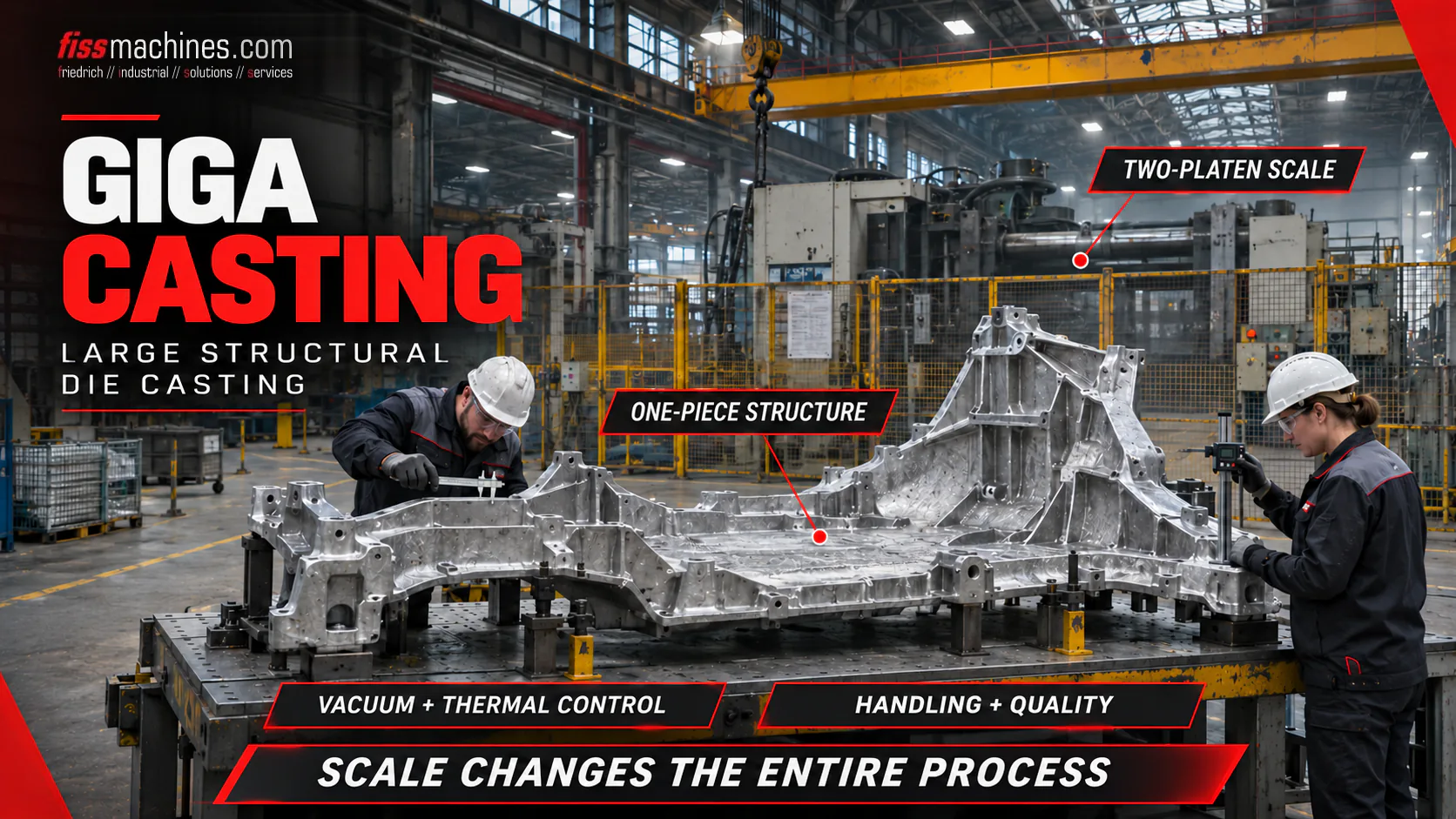
Giga casting – also called mega casting – is high-pressure die casting of very large structural components, such as front or rear underbodies, in one piece. The single casting replaces an assembly of many stamped, welded or riveted parts; Bühler places the machines for this in a clamping force range of 50,000 to 92,000 kN, and even larger machines have been announced.
Technically, giga casting remains cold-chamber die casting. What changes is the scale of die, shot, thermal management, handling and plant.
Giga Casting, Mega Casting and Structural Die Casting
Giga Press is IDRA’s product name, megacasting is Bühler’s term, and gigacasting the general media term. A paper from Chalmers University and Volvo Cars (2026) describes megacasting, “sometimes known gigacasting”, as a form of high-pressure die casting “distinguished primarily by the sheer size of the components produced”.
Joined Body Structure
Many stamped parts are welded, riveted or bonded. Lap joints allow geometric compensation in assembly.
Large Cast Nodes
Individual structural castings, produced on large but conventional cold-chamber machines.
One-Piece Section
A whole body section in one piece. Joining operations disappear – and with them the chance to correct deviations later.
Bühler states that one megacasting replaces “the assembly of 50 to 100 smaller parts” (manufacturer statement, press release of 5 June 2025). Such figures depend on the vehicle design.
Giga Casting Machine Sizes: What Manufacturers State
The overview contains only manufacturer statements with the date of the source; they are not independently verified. “Tons” in model names means tonnes-force of clamping force (about 9.81 kN each).
| Manufacturer | Series / Model | Stated Clamping Force | Manufacturer Source |
|---|---|---|---|
| Bühler | Carat, two-platen series | 10,500 to 92,000 kN | Carat product page, accessed November 2026 |
| Bühler | Carat 840 and Carat 920 | up to 92,000 kN | Press release, 3 November 2021 |
| Bühler | Carat 610 | 61,000 kN | Company story, 30 September 2024 |
| IDRA | Giga Press NEO 5500 / 6100 / 8000 / 9000 | 55,000 / 60,000 / 80,500 / 90,500 kN | Giga Press catalogue (undated), accessed November 2026 |
| L.K. Technology | 16000T; 20,000-ton Giga Press | 16,000 t (launched October 2023); 20,000 t in joint development | Press release, 15 December 2023 |
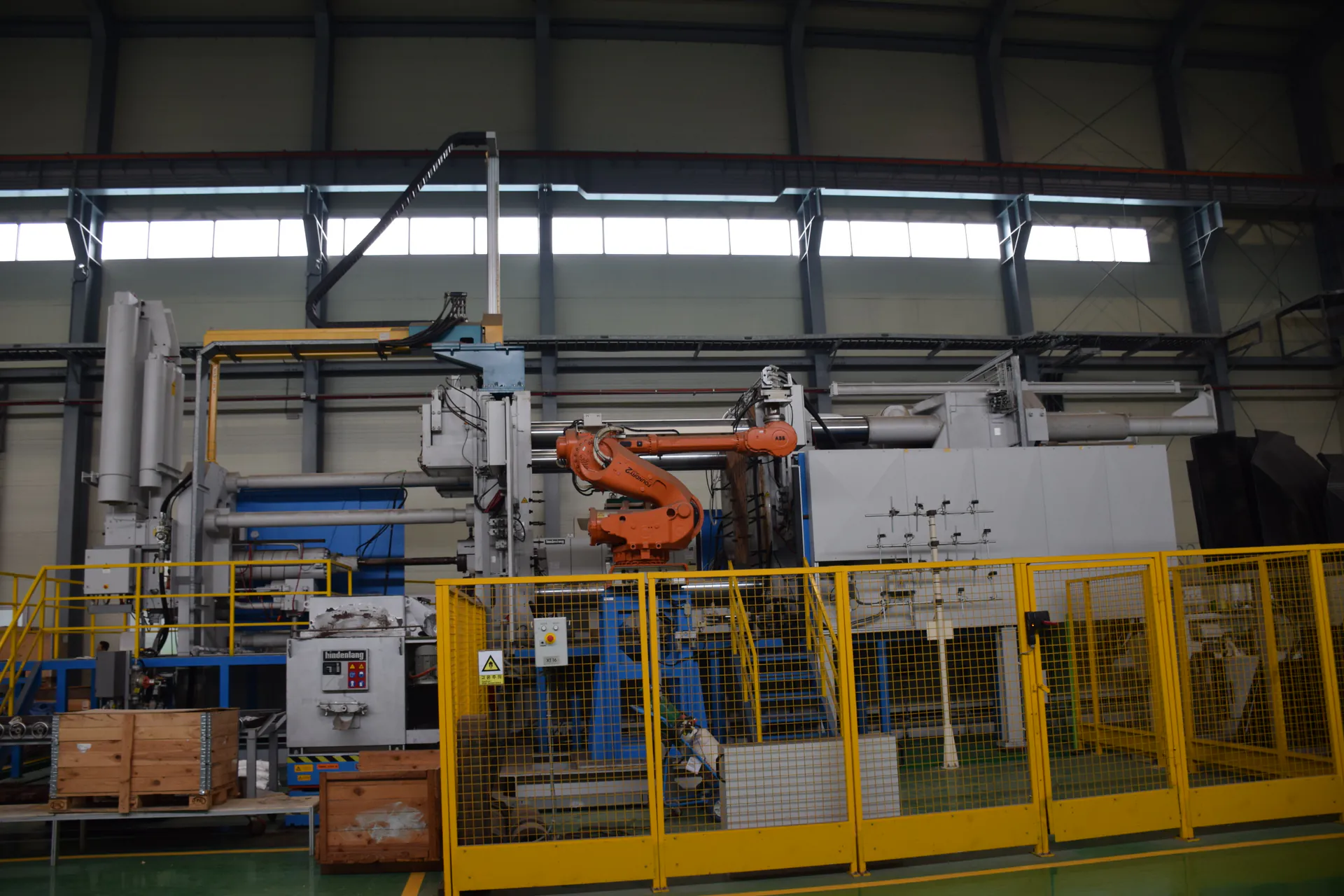
Bühler describes the Carat 610 as about 60 feet (around 18 m) long and over 800,000 pounds in weight – and only the third-largest machine in its megacasting portfolio. IDRA reported production start of its first 9000 t Giga Press at Hyundai in a news item dated 6 November 2024. Machine overviews by brand are available on the FISS pages for Bühler and IDRA.
Two-Platen or Toggle at Giga Casting Scale?
The basic differences between the two clamping principles are explained in Toggle or Two-Platen Machine? At giga scale, two points weigh heavily. First, length: Bühler states that removing the third platen shortens the Carat by up to two metres and allows “higher die locking forces in the same physical space” (manufacturer statement, product page). Second, force is set hydraulically, not via tie-bar preload.
Yet two-platen is not the only route: IDRA’s Giga Press page describes a new guarding system that makes the previous “toggle guarding” unnecessary – a reference that points to a toggle clamping unit (manufacturer page, wording as of November 2026). How the required force is derived from projected area and metal pressure is shown in Clamping Force in Die Casting – the logic is the same, only the projected area is much larger.
Process Requirements of Giga Casting
The machine alone does not make a good part. The Chalmers study names die temperature, cooling channel placement, solidification time, ejection and quenching as key influences on distortion; Bühler names “thermal management and spraying” as key.
Low Gas Content
Evacuating the cavity reduces gas porosity – important for ductile, joinable parts. Bühler offers SmartVac as a Carat option. See Mold Filling and Vacuum.
Properties in the As-Cast State
Alloys such as TRIMET’s trimal-37 (AlSi9Mn) are offered as heat treatment-free, avoiding a step that could distort a large part.
Uniform Thermal Field
Large dies with varying wall thickness need zoned temperature control against hot spots. See Temperature Control in Die Casting.
Removing Gating and Overflows
Misaligned trimming tools or released residual stress can affect geometry. See Trimming in Die Casting.
Handling matters too: according to the Chalmers interviews, robots typically grip the biscuit, but long, thin castings may need other gripping methods.
Foundation, Hall Crane and Logistics for a Giga Casting Cell
A machine of several hundred tonnes changes the building requirements. The following points are project-specific and must be defined with the manufacturer, structural engineers and responsible authorities:
- Foundation designed for machine weight, dynamic loads and the manufacturer’s levelling tolerances
- Hall crane capacity and hook height for die changes and maintenance of heavy assemblies
- Floor space for the complete cell including dosing, spraying, quenching and trimming
- Transport routes and assembly space for the heaviest components
- Handling of return material: Bühler mentions remelting runners and biscuits on site
Distortion, Quality and the Repairability Debate
A giga casting shortens the tolerance chain but removes adjustment possibilities. The Chalmers paper calls geometrical distortion “a key barrier” to robust implementation; in its tests, higher die temperature, longer solidification and milder quenching reduced distortion – at the expense of cycle time.
Crash repairability is debated. A Ducker white paper, reported by Fleet World, warned that replacing whole cast sections could make vehicles uneconomical to repair. A Thatcham Research study on the Tesla Model Y, reported by EUROGUSS 365 in October 2025, found lower repair costs than comparable conventional structures – because affordable partial replacement parts and repair procedures exist. Thatcham’s conclusion: repairability must be designed in from the start.
Who Giga Casting Suits – and Who It Does Not
The economics of giga casting can only be assessed per project. Fewer parts and joining operations are offset by high investment in machine, die and building, and by the risk that one scrapped part is a whole body section. Chalmers notes that high machine and tooling costs make extensive trial and error impractical.
Check Volume and Stability
High, predictable volumes of one platform over many years. Changing part families favour conventional machines.
Check Engineering Capacity
Simulation, thermal die design, distortion compensation and repair concepts need experienced teams.
Check the Site
Foundation, crane, floor space and media supply must be realistic for the cell.
Compare Alternatives
Several smaller structural castings on conventional machines can mean lower risk and more flexibility.
For most job shops, giga casting is a market trend rather than an investment option – one that shifts demand towards structural parts, vacuum and temperature control.
Giga Casting Is a System, Not Just a Bigger Machine
Giga casting combines the largest die casting machines, special alloys, demanding thermal management and open questions on quality and repair. Whether it fits depends less on the machine than on volume, engineering capacity and plant. For everyone else, well-chosen conventional cold-chamber machines remain the more flexible solution.
Questions About Giga Casting
Is Giga Casting a Different Process from High-Pressure Die Casting?
No. Giga casting is cold-chamber high-pressure die casting at a much larger scale. The differences lie in machine and die size, thermal management, handling and plant.
What Clamping Force Does a Giga Casting Machine Have?
Bühler places its megacasting machines at 50,000 to 92,000 kN, with up to 92,000 kN for the Carat 840 and 920, and IDRA lists 90,500 kN for the Giga Press NEO 9000. L.K. Technology has announced even larger machines.
Are Giga Castings Repairable After an Accident?
That depends on the vehicle design. A Thatcham Research study on the Tesla Model Y found competitive repair costs thanks to affordable partial replacement parts. Without such provisions, critics warn of uneconomical repairs.
Are Used Giga Casting Machines Available?
Rarely. Bühler launched its largest Carat models in 2021, and IDRA cites production since 2020, so the installed base is still young. Used machines are more readily available in conventional cold-chamber sizes.
Cold-Chamber Die Casting Machines from FISS.
Not every structural part needs the largest machine. FISS lists used cold-chamber die casting machines and helps you assess which size fits your parts.
Sources
Bühler Group: Carat Die-Casting Machine, product page, buhlergroup.com, accessed 6 November 2026; media release Bühler introduces strongest die-casting machines worldwide, 3 November 2021; Bühler builds first megacasting Carat 610 in North America, 30 September 2024; Bühler celebrates 50 megacasting-solution orders for large structural applications, 5 June 2025; industry page Megacasting, accessed 6 November 2026.
IDRA Group: Giga Press, product page and Giga Press catalogue (NEO 5500–9000), idragroup.com, accessed 6 November 2026; news Proud to announce the installation of the first Giga Press 9000 at Hyundai, dated 06.11.2024.
L.K. Technology Holdings: L.K. Technology Collaborates with Nezha Motors to Introduce the World’s First 20,000-ton Giga Press, press release via Media OutReach, 15 December 2023.
K. Wärmefjord, J. Hansen, R. Söderberg: Experimental and industrial insights into distortion control for megacasting, Procedia CIRP 145 (2026), pp. 252–257.
TRIMET: trimal-37 – heat treatment-free alloy, product page, trimet.eu, accessed 6 November 2026.
EUROGUSS 365: report on the Thatcham Research study on Tesla’s mega cast technology, 20 October 2025; Fleet World: A. Grant, Breaking the mould: the rise of gigacasting and the implications for fleets (with reference to a Ducker white paper), accessed 6 November 2026.
