




Core Shooting Machines Explained: Processes, Machine Types and Buying Criteria
Water jackets, oil channels, intake ports: many internal contours of a casting cannot be formed by the outer mould. They are created by sand cores produced on a core shooting machine. Which machine fits depends mainly on the binder process, the core size and the automation of the core shop.
What Does a Core Shooting Machine Do?
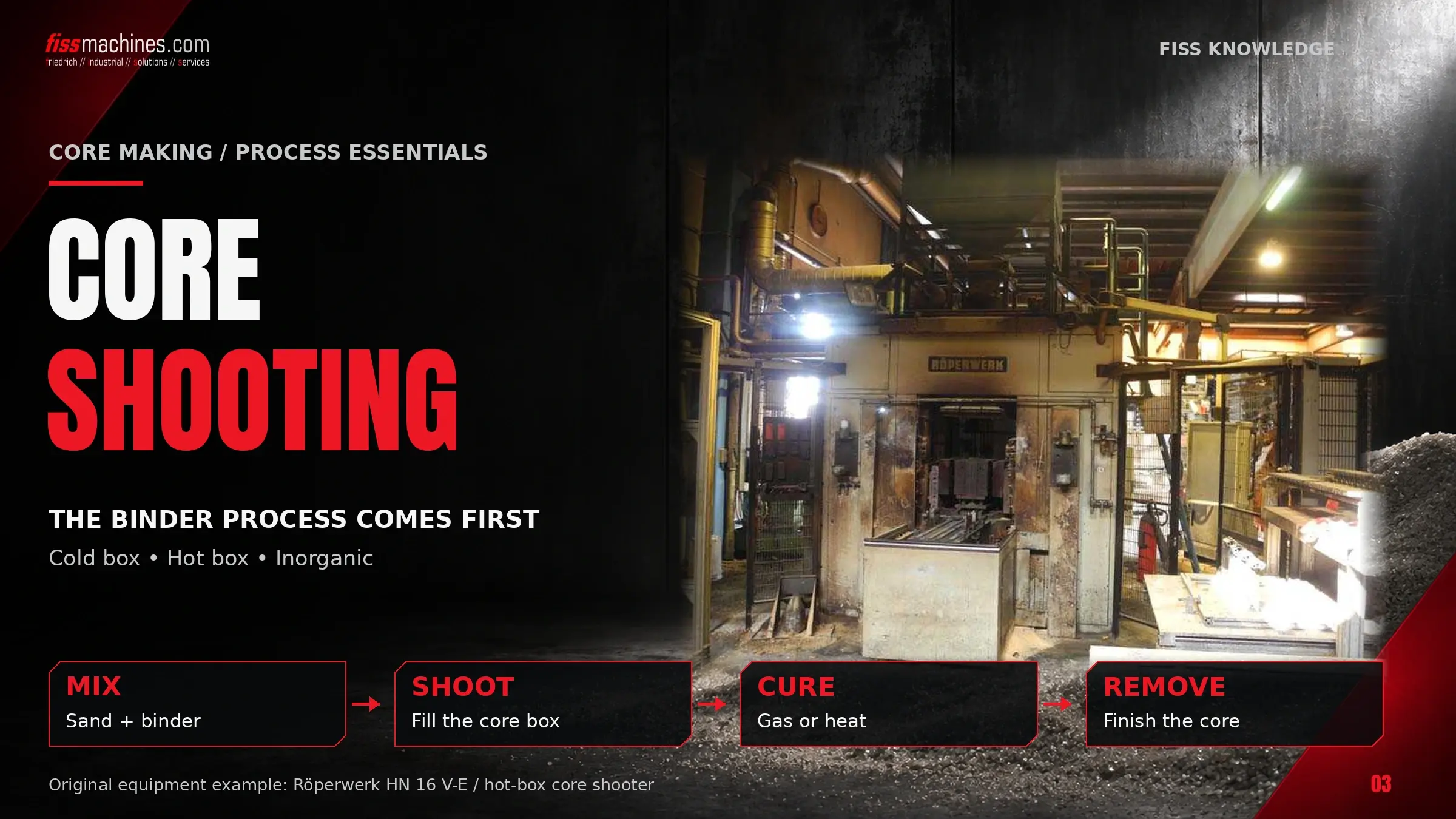
A core shooting machine blows a mixture of sand and binder with compressed air into a core box, where the core is cured – by gassing (cold box with amine, CO₂ with water glass) or by heat (hot box, warm box, croning, inorganic systems). The core is then removed, finished and later placed in the mould.
Machines differ in shot volume, core box size, parting direction, heating, gassing equipment and automation. The binder process is the first decision – it determines what the machine needs.
Why Foundries Need Sand Cores
Metal cores and slides can only form contours that can be pulled out after casting. Undercut channels and closed cavities need a lost core that is broken out afterwards. Sand cores are therefore typical for gravity die casting and low-pressure die casting, for example in cylinder heads and pump or valve housings.
Prepare the Sand Mix
Core sand is mixed with the binder components and fed to the sand magazine of the shooting head.
Shoot
Compressed air blows the mix through shooting nozzles into the closed core box and compacts it.
Cure
The core is gassed or cured by the heat of the core box, sometimes supported by hot air.
Remove and Finish
The box opens, the core is removed and, as required, deburred, coated or assembled into a core package.
Cold Box, Hot Box, Croning, Inorganic: The Processes Compared
The binder process defines how the core cures and what machine and core box must provide. Exact processing windows are set by the binder supplier’s data sheets.
| Process | Curing Principle | Core Box | Practical Points |
|---|---|---|---|
| Cold box (PUR-amine) | Phenolic resin and isocyanate form polyurethane, started by gassing with a tertiary amine | Not heated; metal, plastic or wood possible | Fast and productive; gassing and exhaust air treatment required |
| Hot box / warm box | Resin with latent catalyst cures through the heat of the core box | Heated metal box | Proven for complex cores; energy for box heating |
| Croning (shell) | Resin-coated sand cures in the hot box | Heated, around 250 °C according to ASK Chemicals | High dimensional accuracy; emissions during core making |
| Inorganic | Water-based binder with additive, cured by heat and hot-air purging | Heated, around 150–210 °C according to ASK Chemicals | Hardly any harmful emissions; cores sensitive to humidity |
| CO₂ (water glass) | Water-glass-bonded sand is gassed with CO₂ | Not heated | Simple, but lower strength and moderate output |
FISS lists used core shooters for cold box, hot box, CO₂ and croning. Inorganic systems are used above all in high-volume aluminium production, for example of engine and e-motor housings.
Cold Box Process: Gassing, Purging and Amine Scrubbing
According to ASK Chemicals, the cold box PU process cures very quickly, gives high early strength and allows cores to be coated and assembled shortly after shooting. Binder additions are usually 0.4–1.2 % per binder part. As the core box is not heated, box changes are quick and tooling and energy costs are low.
The machine needs a gassing unit that vaporises the liquid amine, for example DMEA or TEA, and carries it into the core box. An air purge then removes residual amine. The exhaust air is typically cleaned in an acid scrubber: sulfuric or phosphoric acid binds the amine as a salt, and the spent acid must be disposed of or recycled.
Heated Core Boxes: Hot Box, Croning and Inorganic Binders
Heat Completes the Cure
Moist, organically bonded sand is shot into a heated metal box; stored heat completes the cure. Hüttenes-Albertus offers phenolic, furan and urea-modified resins.
Low Free Formaldehyde
Variant with urea-modified furfuryl alcohol resins, according to Hüttenes-Albertus with very low free formaldehyde; used for grey iron and aluminium.
Resin-Coated Sand
Pre-coated sand cures in the hot box. Suited to accurate, thin-walled and shell cores; drawbacks are heated tooling and emissions.
Heat Plus Hot Air
Heated box and hot-air purging remove the water from the binder. Cores need dry storage.
For all heated processes, core box heating is a key feature: electric elements or gas burners, temperature control per box half and enough power for the box size. Uneven temperatures cause soft spots or burnt core surfaces.
Machine Types: Size, Parting and Design
Horizontal or Vertical
With vertical parting the box opens sideways, with horizontal parting upwards and downwards. Many machines accept both; core geometry and removal concept decide.
From Small Cores to Large Packages
Shot volumes range from a few litres to several hundred. Laempe specifies 2.5–16 l for its LD series and 30–300 l for the LHL series (manufacturer statements).
Single Station or Rotary Table
Rotary-table machines such as the LD series, based on Röperwerk technology, shoot, cure and remove in parallel for small and medium cores.
Box Dimensions and Weight
Shooting area, tool height, width, depth and weight limit which core boxes fit. Multi-part boxes need additional drives.
According to Laempe Mössner Sinto, Hottinger and Röperwerk were incorporated into the company in 2009, so it is worth asking there about spare parts and documentation for older machines of these brands. Loramendi is another established supplier, including lines for inorganic cores.
Automation in the Core Shop
- Core removal by the machine or by robot with adapted gripper
- Robot-guided deburring of parting lines and shooting marks
- Coating of cores, followed by drying
- Assembly of individual cores into core packages
- Automatic core box changers and cleaning stations
- Sand supply with mixer, binder dosing and magazine filling
The more periphery is included, the more important the interfaces become: signals between machine, robot and sand plant, safety circuits and the software status of the control.
Buying a Used Core Shooting Machine: What to Check
- Process: Heating for hot box, croning or inorganic, gassing unit for cold box or CO₂?
- Shot volume and sand magazine: Sufficient for the heaviest core plus reserve?
- Core box mounting: Shooting area, clamping dimensions, tool weight and parting suitable for existing boxes?
- Shooting head: Wear of nozzles and seals, shooting valve, compressed air supply
- Exhaust air: Gassing unit, scrubber and extraction included and documented?
- Control and documents: Software status, spare parts, circuit diagrams, CE documentation
Older machines can often be updated with new controls and safety technology, see Overhaul or Retrofit? FISS also supports the start-up of relocated machines.
The Process Comes First, the Machine Second
A core shooting machine is only as good as its fit to binder process, core size and periphery. Define the process, the heaviest core and the required automation first – then new and used machines can be compared on a sound basis. Available machines are listed in the FISS core shooters category.
Questions About Core Shooting Machines
Can a Hot Box Machine Be Used for Cold Box?
Only after conversion: cold box needs a gassing unit, a sealed gassing plate, exhaust air treatment and core boxes designed for gassing. Whether this pays off should be checked with the manufacturer or a specialist.
Why Are Inorganic Binders Used?
Mainly because of emissions: according to binder suppliers, inorganic cores release hardly any harmful gases during casting. Drawbacks are heated tooling, hot-air purging and sensitivity to humidity.
How Large Should the Shot Volume Be?
Larger than the heaviest core including shooting channels, with a reserve. Too small means incompletely filled cores; far too large increases space and costs.
Does FISS Also Supply Complete Core Shop Systems?
Depending on the project, FISS offers individual machines or complete core production systems with sand supply, mixing, gassing, exhaust air technology and core handling.
Used Core Shooting Machines from FISS.
FISS supplies used core shooters for cold box, hot box, CO₂ and croning and searches its network for machines not listed online. Tell us your process and core sizes.
Sources
ASK Chemicals: Cold Box PU Technology, ask-chemicals.com, accessed 5 November 2026.
Foundry Management & Technology / ASK Chemicals: Evaluating Cost, Quality, and Environmental Factors for Shell vs. Cold-Box Coremaking, 2016.
Foundry Management & Technology / ASK Chemicals: Do Inorganic Binders Mean the End for Shell Sand Molding?, 2017.
Hüttenes-Albertus: Hot Box / Warm Box product information, ha-group.com, accessed 5 November 2026.
HA International: HARP scrubber design and operating principles, presentation, 2023.
Laempe Mössner Sinto: Corporate profile and product pages LHL-series and Special machine solutions (LD-series), laempe.com, accessed 5 November 2026.
Mössner: Core handling (robot-guided deburring, coating grippers, core package assembly), moessner-kg.de, accessed 5 November 2026.
FISS Machines: category Core Shooters, fiss-machines.com, accessed 5 November 2026.
